
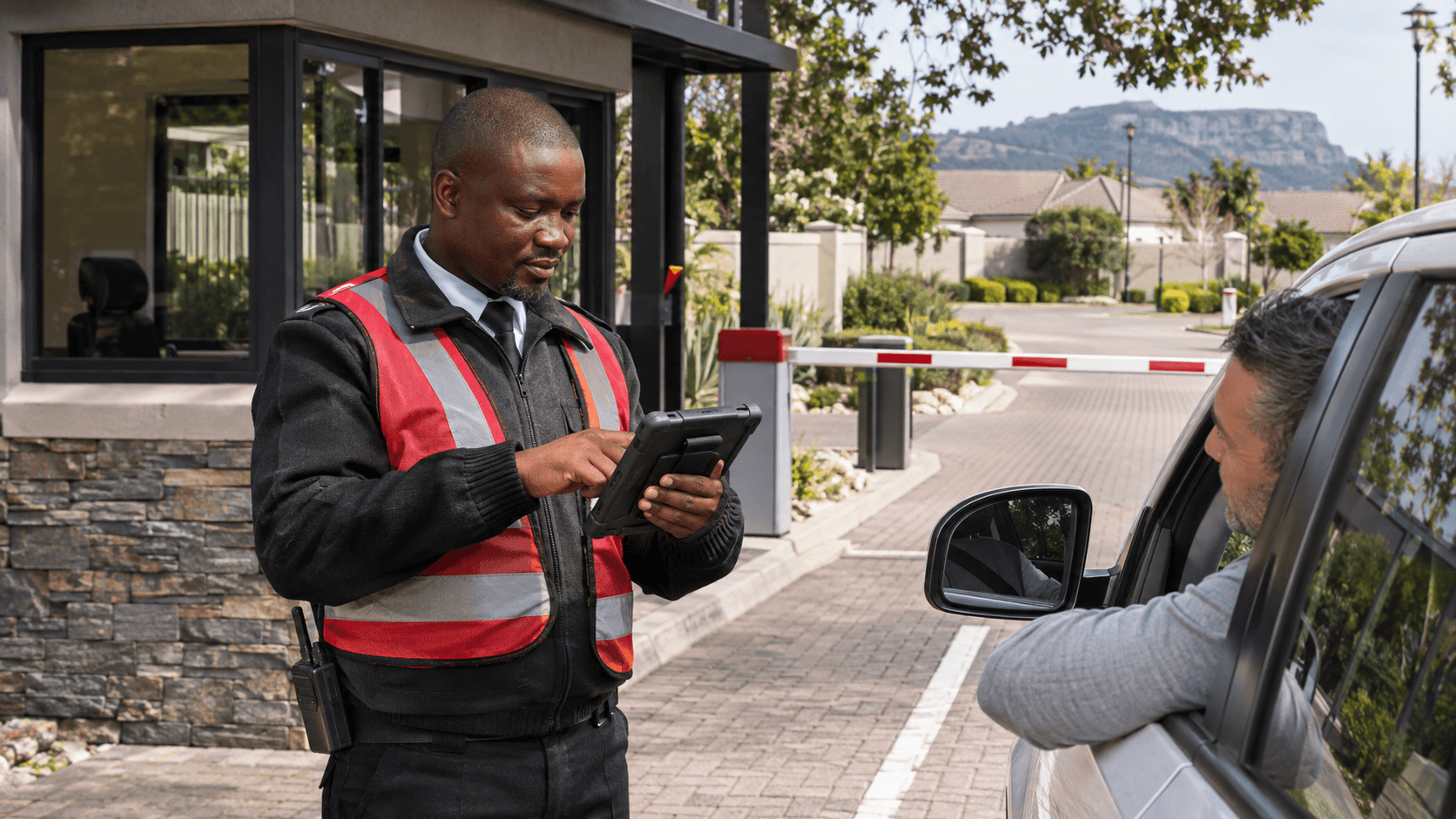
A reliable visitor check-in process helps a South African estate know who is entering, why they are arriving and how the visit was handled. It should give security guards clear steps, create useful records for authorised managers and remain practical for residents, contractors, delivery drivers and guests. The goal is not to make every arrival slower or collect every possible detail. It is to make the necessary checks consistent.
Many estates still depend on a handwritten visitor book at the gate. That approach can work for a small number of arrivals, but it becomes difficult to manage when traffic increases, several guards share the work or an incident must be reviewed later. Improving check-in starts with understanding where paper and inconsistent manual processes create avoidable risk.
Why handwritten visitor books create gaps
A paper book records what someone writes down, not necessarily what the estate needs to know. Names may be abbreviated, identity numbers may be copied incorrectly and vehicle details may be omitted when the entrance is busy. Different guards may also record the same type of visit in different ways.
Paper records are difficult to search quickly. If a manager needs to establish who entered during a particular period, the answer may depend on finding the correct book, reading several pages and interpreting handwriting. Books can also be damaged, misplaced or left open where people nearby can see information that should be handled carefully.
These weaknesses do not mean every paper entry is inaccurate. They show why an estate needs a defined process, trained operators and a recordkeeping method that supports the process rather than relying on memory and handwriting alone.
Start with a consistent check-in workflow
Before choosing a system, document the steps that every guard should follow. A practical workflow usually answers five questions:
- Who is the visitor and what information is necessary to identify the visit?
- Who are they visiting, or which contractor, delivery or service task brings them to the estate?
- What verification does the estate require before access is allowed?
- Who may approve an exception when information is missing or does not match?
- What record must be retained, and who may access it afterwards?
The answers should be written in plain language and applied at every entrance. A consistent workflow makes training easier and reduces the chance that one guard skips an important step while another asks for unnecessary information.
Separate registration from the access decision
Visitor registration and access approval are related, but they are not the same decision. Registration captures the information needed to understand the arrival. Approval follows the estate's rules and may depend on the resident, the visit, the visitor's identity or the vehicle being used.
This distinction helps guards work methodically. A visitor can be registered while the guard confirms the host or checks an exception. If access is declined, the estate still has a clear record of what was presented and what decision was made, subject to its retention policy.
Give guards practical tools and clear instructions
Security guards work under pressure. They may be handling several arrivals, answering a radio call and managing a vehicle lane at the same time. A good check-in process should reduce unnecessary typing and repeated questions without removing the guard's responsibility to apply the estate's policy.
Where supported documents are used, a mobile visitor-identification device can help capture relevant details more consistently than copying them by hand. The Identiscan MT93 mobile scanner is intended for visitor and vehicle information capture at the point of entry. It supports the guard's workflow, but it does not replace the estate's rules or the guard's judgement.
Instructions should also cover common exceptions. Guards need to know what to do when a visitor arrives for the wrong property, a document cannot be read, a contractor's details have changed, a host cannot be reached or the system is temporarily unavailable. A short escalation procedure is more useful than asking each guard to improvise.
Use digital records to improve accountability
Digital visitor management can provide a more structured record than a paper book. Depending on the estate's configuration and policy, authorised users may be able to review visitor details, vehicle information, arrival times and the way an entry was processed. A consistent record can help managers investigate incidents, review recurring delays and identify where training is needed.
Recordkeeping is most useful when the information is accurate and connected to a clear purpose. Estates should decide which fields are required, standardise how names and vehicle details are captured and avoid making guards complete fields that no one uses. A longer form is not automatically a better security process.
Vehicle recognition can also form part of a wider access process. Identiscan's licence plate recognition solution can identify vehicle registration plates for configured access-control workflows. It should be treated as vehicle information, not proof of the driver's identity. The estate still needs an appropriate process for visitors, passengers, changed vehicles and unreadable plates.
Improve consistency without creating delays
Consistency does not require every arrival to follow an identical path. Residents, expected visitors, contractors, deliveries and once-off guests may need different checks. The important point is that the differences are defined in advance and applied fairly.
- Use a short routine path for expected visitors whose details are available.
- Keep a separate procedure for exceptions so one uncertain arrival does not disrupt every vehicle.
- Tell residents what information visitors need before they arrive.
- Give contractors and service providers clear instructions for recurring visits.
- Review the process at shift handover so guards share the same current information.
Managers should measure the process using practical indicators such as incomplete registrations, host-confirmation delays, repeated manual corrections and the number of entries sent to an exception process. These measures can reveal whether a change is actually improving consistency or merely moving the delay to another part of the entrance.
Handle visitor information responsibly
Visitor information is personal information and should be handled with care. An estate should collect only what it needs for a defined access or security purpose, restrict access to authorised users and keep records for an appropriate period. Guards should not leave books, screens or printed lists visible to people who do not need them.
Management should also define who may correct a record, how an inaccurate entry is handled and when information is securely disposed of. The Identiscan POPIA overview explains why responsibilities, safeguards and retention questions depend on the estate's operating model and configuration. It is not a substitute for the estate's own legal and operational review.
Questions estate managers should ask
Does digital check-in remove the need for security guards?
No. A digital record can support identification and consistency, but guards still apply the estate's access policy, manage exceptions and make decisions that require human judgement.
Should every visitor provide the same information?
Not necessarily. The estate should define information requirements for different visitor types and collect only what is relevant to the legitimate access purpose.
What happens when the system is unavailable?
Every estate should have a documented downtime procedure. It should state which checks continue, who may approve entry and how temporary records will be reconciled afterwards.
How can an estate tell whether check-in is improving?
Compare incomplete records, processing delays, exception volumes and correction rates before and after a change. Also ask guards and residents where the process remains unclear.
Build a check-in process people can follow
Improving visitor check-in is not about adding technology to an undefined process. It is about deciding what the estate needs to know, giving guards a repeatable workflow, recording information consistently and protecting it afterwards. Digital visitor management and document scanning can support that work when they are configured around the estate's policy.
Identiscan provides tools for visitor and vehicle information capture, access records and related identification workflows. Estates can book a demonstration to discuss how those tools may fit their entrance procedures, responsibilities and privacy requirements.